

Table of Contents
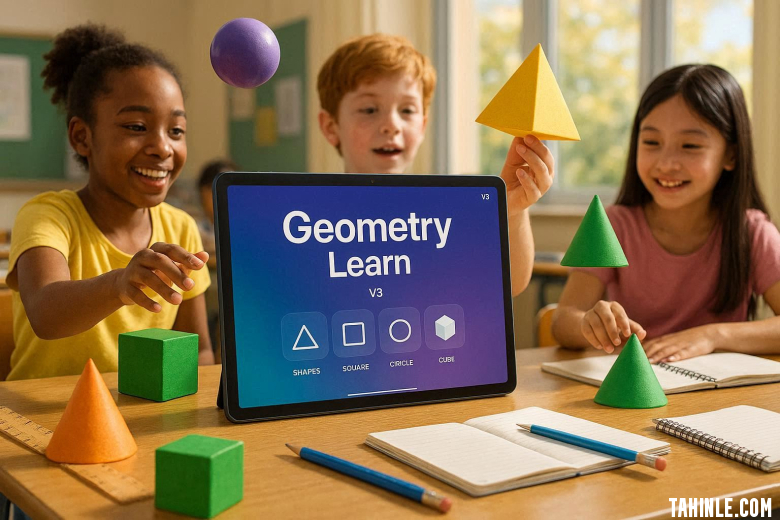
ToggleGeometry can feel overwhelming when it is taught through memorization alone. Many students struggle to connect formulas, shapes, and theorems with real understanding. Geometry Learn V3 changes that experience by turning geometry into a visual, interactive, and practice-driven process. Built for students, teachers, homeschoolers, and self-learners, this modern platform helps users understand geometric concepts through direct manipulation, adaptive learning, and real-time feedback.
Unlike traditional worksheets or static lessons, Geometry Learn V3 focuses on helping learners see geometry in action. From drawing angles to testing transformations and solving proofs, it creates an engaging environment where geometry becomes easier to understand and apply.
What Is Geometry Learn V3?
Geometry Learn V3 is an advanced digital learning platform designed to teach geometry step by step through visuals, interaction, and guided learning. Instead of overwhelming students with abstract formulas, the platform introduces concepts gradually and builds mastery through practice.
The system emphasizes clarity, confidence-building, and active learning. Students do not simply watch lessons — they interact with shapes, manipulate figures, and receive immediate feedback. This creates a stronger understanding of geometry fundamentals while reducing confusion.
The platform’s philosophy is simple: practice-driven learning leads to long-term mastery. Rather than skipping foundational skills, Geometry Learn V3 reinforces concepts until learners develop true understanding.
Interactive Geometry Tools That Improve Understanding
One of the strongest features of Geometry Learn V3 is its collection of interactive geometry tools. Students gain access to digital rulers, compasses, protractors, and transformation controls that mimic real-world geometry instruments.
These tools allow learners to:
- Draw geometric shapes accurately
- Measure angles and distances
- Create constructions directly on screen
- Experiment with geometric relationships
This hands-on environment is especially helpful for visual learners. Geometry becomes easier when students can physically manipulate shapes rather than only reading about them.
Interactive learning encourages exploration. A student can test ideas instantly, adjust measurements, and observe patterns. This transforms geometry from a memorization-heavy subject into an engaging problem-solving experience.
Real-Time Shape Manipulation Makes Learning Easier
Traditional geometry books often rely on static diagrams. Geometry Learn V3 solves this limitation through real-time shape manipulation.
Users can rotate, resize, stretch, or reposition shapes and immediately see how those changes affect angles, sides, and proportions. When a triangle’s angle changes, the entire figure updates automatically.
This dynamic interaction helps students understand relationships such as:
How Angles Affect Shape Structure
Changing one angle demonstrates how geometric balance shifts within polygons and triangles.
Understanding Similarity and Congruence
Students visually compare shapes and discover why figures are similar or congruent.
Learning Through Experimentation
Instead of guessing, learners test geometry rules in real time.
This feature is especially powerful for learners who struggle to understand geometry through text explanations alone.
Guided Learning Modules for Step-by-Step Progress
Geometry Learn V3 uses a structured learning model that makes geometry easier to follow. Every lesson follows a 4-step instructional process:
- Introduce the concept
- Show a visual example
- Allow interactive practice
- Provide feedback and explanation
This method creates a natural learning progression. Concepts build upon each other instead of appearing disconnected.
Students move from understanding simple ideas like lines and angles to more advanced topics such as proofs and coordinate geometry. Because lessons are scaffolded, learners feel less intimidated and more motivated to continue.
The guided format also benefits teachers who need a consistent curriculum structure for classroom instruction.
Adaptive Learning Support for Personalized Education
Not every student learns at the same speed. Geometry Learn V3 addresses this challenge through adaptive learning technology.
The system tracks performance and adjusts difficulty automatically.
- If a student struggles, additional guidance appears
- If a learner improves, the challenge level increases
- Weak topics receive more review opportunities
This personalization creates a more effective learning experience. Students no longer feel rushed or left behind.
Adaptive learning also improves confidence because learners practice at a pace that matches their ability level.
Topics Covered in Geometry Learn V3
Geometry Learn V3 supports a wide range of mathematical concepts, making it suitable for beginners and advanced learners alike.
Foundational Geometry Topics
Students learn:
- Points, lines, and angles
- Triangles and polygons
- Circles and symmetry
- Plane geometry basics
Advanced Geometry Concepts
More advanced modules include:
- Coordinate geometry
- Transformations and reflections
- Surface area and volume
- Geometric proofs and deductive reasoning
The platform also introduces spatial reasoning, helping learners understand 3D shapes, nets, and volume relationships.
Geometry Learn V3 Compared to Other Learning Platforms
Many geometry platforms exist, but Geometry Learn V3 stands out due to its visual-first design.
| Tool | Strength | Best For |
|---|---|---|
| GeoGebra | Deep graphing and construction tools | Open-ended exploration |
| Khan Academy | Video-based structured learning | Traditional lessons |
| Geometry Learn V3 | Interactive practice + visual manipulation | Fast mastery and visual learning |
While other platforms focus heavily on videos or graphing, Geometry Learn V3 prioritizes hands-on engagement and direct experimentation.
This makes it especially useful for students who need to see geometry concepts rather than only hear explanations.
Why Geometry Learn V3 Is Popular in 2026
Teachers and students increasingly prefer tools that encourage engagement. Geometry Learn V3 has gained attention because it combines research-backed learning strategies with modern technology.
According to Dr. Shanice Vega, Mathematics Curriculum Specialist:
“Formative assessment, immediate feedback, and active manipulation of geometric objects are game-changers in mathematics education.”
Schools testing Geometry Learn V3 reported improved student participation, especially in proof-based problem solving.
The platform also connects geometry to real-world applications, showing learners how geometry influences:
- Architecture
- Navigation systems
- Artificial intelligence
- Computer graphics
- Mobile screen design
By connecting geometry to everyday life, students better understand why these concepts matter.
Who Should Use Geometry Learn V3?
Geometry Learn V3 works for a wide audience.
It is ideal for:
- Students in grades 4–12 needing extra geometry support
- Teachers seeking classroom-ready lessons and tracking tools
- Self-learners preparing for exams
- Homeschoolers requiring structured geometry instruction
The flexibility of the platform makes it useful for both classroom and independent learning.
Final Thoughts on Geometry Learn V3
Geometry Learn V3 transforms geometry from a difficult subject into an interactive learning experience. Through real-time manipulation, adaptive feedback, guided modules, and visual tools, learners gain a deeper understanding of shapes, angles, proofs, and spatial relationships.
Instead of memorizing formulas without context, students experience geometry directly. This creates stronger retention, better confidence, and improved problem-solving ability.
For anyone looking to master geometry in 2026, Geometry Learn V3 offers a modern, engaging, and highly effective solution.